




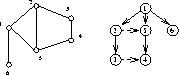
Figure: An undirected graph and its breadth-first search tree
The basic breadth-first search algorithm is given below.
At some point during the traversal,
every node in the graph changes state from undiscovered
to discovered.
In a breadth-first search of an undirected graph,
we assign a direction to each edge, from the discoverer u to the
discovered v.
We thus denote u to be the parent p[v].
Since each node has exactly one parent, except for the root, this
defines a tree on the vertices of the graph.
This tree, illustrated in Figure  ,
defines a shortest path from the root to every other node in
the tree.
This property makes breadth-first search very useful in
shortest path problems.
,
defines a shortest path from the root to every other node in
the tree.
This property makes breadth-first search very useful in
shortest path problems.
BFS(G,s)
for each vertex
do
state[u] = ``undiscovered''
p[u] = nil, i.e. no parent is in the BFS tree
state[] = ``discovered''
p[] = nil

while
do
u = dequeue[Q]
process vertex u as desired
for each
do
process edge (u,v) as desired
if state[v] = ``undiscovered'' then
state[v] = ``discovered''
p[v] = u
enqueue[Q,v]
state[u] = ``completely-explored''
The graph edges that do not appear in the breadth-first search tree
also have special properties.
For undirected graphs, non-tree edges
can point only to vertices on the same level as the parent
vertex or to vertices on the level directly below the parent.
These properties follow easily from the fact that each path in the
tree must be the shortest path in the graph.
For a directed graph, a back-pointing edge  can
exist whenever v lies closer to the root than u does.
can
exist whenever v lies closer to the root than u does.
The breadth-first search algorithm above includes places to optionally process each vertex and edge, say to copy them, print them, or count them. Each vertex and directed edge is encountered exactly once, and each undirected edge is encountered exactly twice.