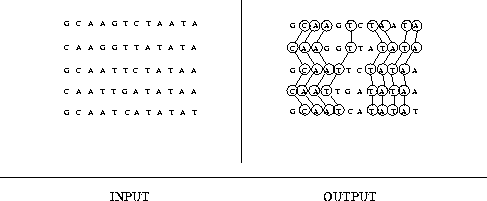

Input description: A set S of strings  .
.
Problem description: What is the longest string S' such that for each  ,
,
 , the characters of S appear as a
subsequence of ?
, the characters of S appear as a
subsequence of ?
Discussion: The problem of longest common subsequence arises whenever we search for similarities across multiple texts. A particularly important application is in finding a consensus among DNA sequences. The genes for building particular proteins evolve with time, but the functional regions must remain consistent in order to work correctly. By finding the longest common subsequence of the same gene in different species, we learn what has been conserved over time.
The longest common substring problem
is a special case of edit
distance (see Section  ),
when substitutions are forbidden and
only exact character match, insert, and delete are allowable edit operations.
Under these conditions,
the edit distance between p and t is n+m-2 |lcs(p,t)|,
since we can delete the
missing characters from p to the lcs(p,t) and insert the missing characters
from t to transform p to t.
This is particularly interesting because
the longest common subsequence can be faster to compute than edit distance.
),
when substitutions are forbidden and
only exact character match, insert, and delete are allowable edit operations.
Under these conditions,
the edit distance between p and t is n+m-2 |lcs(p,t)|,
since we can delete the
missing characters from p to the lcs(p,t) and insert the missing characters
from t to transform p to t.
This is particularly interesting because
the longest common subsequence can be faster to compute than edit distance.
Issues arising include:
The longest common substring of a set of strings can be identified in
linear time using suffix trees, discussed in Section .
The trick is to build a suffix tree containing all the strings, label
each leaf with the set of strings that contain it, and then
do a depth-first traversal to identify the deepest node that has descendents
from each input string.
For the rest of this discussion, we will restrict attention to finding
common scattered subsequences.
Dynamic programming can be used to find the longest common
subsequence of two strings, S and T, of n and m characters each.
This algorithm is a special case of the edit-distance computation
of Section .
Let M[i,j] denote the number of characters in the longest common substring
of  and
and  .
In general, if
.
In general, if  , there is no way the last pair of characters
could match, so
, there is no way the last pair of characters
could match, so  .
If S[i] = T[j], we have the option to select this character for our substring,
so
.
If S[i] = T[j], we have the option to select this character for our substring,
so  .
This gives a recurrence that computes M, and thus finds the length of
the longest common subsequence in O(nm) time.
We can reconstruct the actual common substring
by walking backward from M[n,m] and establishing which characters
were actually matched along the way.
.
This gives a recurrence that computes M, and thus finds the length of
the longest common subsequence in O(nm) time.
We can reconstruct the actual common substring
by walking backward from M[n,m] and establishing which characters
were actually matched along the way.
 .
Thus r can be as large as mn if both strings consist entirely of the
same character, but r = n if the two strings are
permutations of
.
Thus r can be as large as mn if both strings consist entirely of the
same character, but r = n if the two strings are
permutations of  .
This technique treats the pairs of r as defining points in the plane.
.
This technique treats the pairs of r as defining points in the plane.
The complete set of r such points can be found in O(n + m + r) time
by bucketing techniques.
For each string, we create a bucket for each letter of the alphabet
and then partition all of its characters into the appropriate buckets.
For each letter c of the alphabet, create a point (,t) from every pair
 and
and  , where
  and
and  are buckets for c.
A common substring represents a path through these points that moves only
up and to the right, never down or to the left.
Given these points, the
longest such path can be found in  time.
We will sort the points in order of increasing x-coordinate (breaking
ties in favor of increasing y-coordinate.
We will insert these points one by one in this order, and
for each k,
time.
We will sort the points in order of increasing x-coordinate (breaking
ties in favor of increasing y-coordinate.
We will insert these points one by one in this order, and
for each k,  ,
maintain the minimum y-coordinate of any path going through exactly k
points.
Inserting a new point will change exactly one of these paths by reducing
the y-coordinate of the path whose last point is barely greater than the new
point.
,
maintain the minimum y-coordinate of any path going through exactly k
points.
Inserting a new point will change exactly one of these paths by reducing
the y-coordinate of the path whose last point is barely greater than the new
point.
 time.
A particularly important case of this occurs in finding the longest
increasing subsequence of a sequence of numbers.
Sorting this sequence and then replacing each number
by its rank in the total order gives us a permutation p.
The longest common subsequence of p and
time.
A particularly important case of this occurs in finding the longest
increasing subsequence of a sequence of numbers.
Sorting this sequence and then replacing each number
by its rank in the total order gives us a permutation p.
The longest common subsequence of p and  gives the
longest increasing subsequence.
gives the
longest increasing subsequence.
 time, where n is the length of the longest string.
This algorithm is exponential in the number of strings k,
and so it will likely be too expensive for more than 3 to 4 strings.
Further, the problem is NP-complete, so no better exact algorithm is destined
to come along.
time, where n is the length of the longest string.
This algorithm is exponential in the number of strings k,
and so it will likely be too expensive for more than 3 to 4 strings.
Further, the problem is NP-complete, so no better exact algorithm is destined
to come along.
This problem of multiple sequence alignment has received considerable
attention, and numerous heuristics have been proposed.
Many heuristics begin by computing the pairwise alignment
between each of the  pairs of strings,
and then work to merge these alignments.
One approach is to build a graph with a vertex for each character of
each string.
There will be an edge between and
pairs of strings,
and then work to merge these alignments.
One approach is to build a graph with a vertex for each character of
each string.
There will be an edge between and  if the corresponding
characters are matched in the alignment between S and T.
Any k-clique (see Section ) in this graph describes a
commonly aligned character, and all such cliques can be found efficiently
because of the sparse structure of this graph.
if the corresponding
characters are matched in the alignment between S and T.
Any k-clique (see Section ) in this graph describes a
commonly aligned character, and all such cliques can be found efficiently
because of the sparse structure of this graph.
Although these cliques will define a common subsequence, there is no reason to believe that it will be the longest such substring. Appropriately weakening the clique requirement provides a way to increase it, but still there can be no promises.
Implementations: MAP (Multiple Alignment Program) [Hua94] by Xiaoqiu Huang is a C language program that computes a global multiple alignment of sequences using an iterative pairwise method. Certain parameters will need to be tweaked to make it accommodate non-DNA data. It is available by anonymous ftp from cs.mtu.edu in the pub/huang directory.
Combinatorica [Ski90] provides a Mathematica implementation
of an algorithm to construct the longest increasing subsequence of
a permutation, which is a special case of longest common subsequence.
This algorithm is based on Young tableaux rather than dynamic programming.
See Section .
Notes: Good expositions on longest common subsequence include [AHU83, CLR90]. A survey of algorithmic results appears in [GBY91]. The algorithm for the case where all the characters in each sequence are distinct or infrequent is due to Hunt and Szymanski [HS77]. Expositions of this algorithm include [Aho90, Man89]. Multiple sequence alignment for computational biology is treated in [Wat95].
Certain problems on strings become easier when we assume a constant-sized
alphabet.
Masek and Paterson [MP80] solve longest common subsequence in
 for constant-sized alphabets, using the
four Russians technique.
for constant-sized alphabets, using the
four Russians technique.
Related Problems: Approximate string matching (see page ),
shortest common superstring (see page ).