Most executives are nervous about discussing
organizational values. Many are downright cynical, and believe that
shared values are something that managers talk about to make their staff
feel good but that have no bearing on performance.
Recent research indicates that shared values do in fact provide a
framework within which people make decisions and take actions that
ultimately affect the performance of their organizations. Values evolve
as an organization tackles and solves the problems it faces. They are
not always articulated. Some are so fundamental to human nature, to a
company, or to an industry that people are not even conscious of them.
Shared values affect performance in three key ways. They provide a
stable base for guiding employee decisions and actions in an otherwise
rapidly changing workplace; they form an integral part of an
organization’s value proposition to customers and staff; and they
energize people to go the extra mile for their company, thereby creating
a source of competitive advantage that is hard to replicate.
Different places, different values
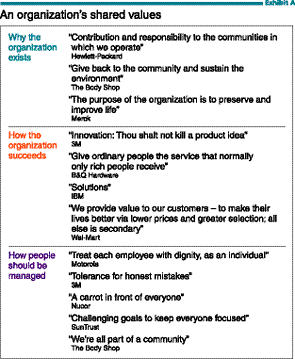
An organization’s shared values usually concern why it exists, how it
succeeds, and how its people should be managed (Exhibit 1). Values in
the last category have a marked impact on productivity. Many executives
search for a universal set of people values that they believe all
successful organizations share. In fact, successful companies in
different industries, and even some companies in the same industry, have
formulated quite distinct sets of people values that work for them.
These companies actively manage shared values to drive performance. They
use carefully designed processes to recruit people who "fit" their
values profile and to develop and reinforce those values.
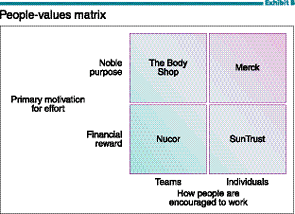
People values tend to fall into two main categories. The first comprises
an organization’s shared values about how people should work
together—for instance, whether it encourages people to work alone or
values joint effort in teams. The second category consists of values
concerning the primary motivation for effort: does the organization
believe people are motivated mainly by competition and reward, or by
some noble purpose? Combining these two dimensions, in a matrix, reveals
that different organizations have developed very different approaches
to managing people (Exhibit 2).
Money and teams
At Nucor, for instance, an important shared value is that people should
work together in teams. The company also believes that money drives
individual performance with competition between teams a secondary
motivator. The front line is structured around operating teams of 25 to
40 people, all of whom are treated equally. Ken Iverson, Nucor’s
Chairman and former CEO, describes management as a necessary overhead
that he keeps to a minimum.
While competition between teams is actively encouraged, cooperation
within teams is valued highly. The pay system is tightly linked to
team—rather than individual—performance, with a monthly report ranking
all divisions on a series of agreed criteria. This report is available
to all managers and details from it are prominently displayed in the
cafeteria. There are no limits to bonus payments, which encourages a
continual escalation in performance levels. Bonuses are paid on a weekly
basis to provide instant feedback on performance. Teams are highly
effective at weeding out poor performers.
Money and individual performance
In contrast to Nucor, SunTrust has developed a shared value of
accountability for individual performance. This is linked to a related
value: that meeting financial goals is the primary motivation for
performance. At SunTrust, there is a belief that you get the best
performance from your people by getting them to agree to goals against
which they are rigorously measured. SunTrust has introduced processes to
help people set their goals as well as systems for monitoring their
performance.
SunTrust’s goal-setting and incentive programs are negotiated by its top
management, local banks, divisions, and frontline officers. Most people
are involved in setting their own tough goals. A key to success has
been SunTrust’s ability to recruit goal-oriented people who pride
themselves in meeting their targets. They have also found it important
that the individuals agree up front about the reasonableness of their
targets. There is monthly feedback on their performance against target
and many incentives are paid on an all-or-nothing basis depending on
performance.
At SunTrust, there are no excuses and no extenuating circumstances. As
at Nucor, there is a strong performance ethic, with great pride in doing
what you say you will do and tremendous enthusiasm and energy to get
things done.
Individuals with noble purpose
Merck, like SunTrust, believes individual endeavor is the key to
performance. It hires the best students and nurtures them in an
environment that promotes both commercial viability and scientific
recognition: within commercial constraints, Merck researchers are
allowed to publish their findings. Dual career ladders are maintained,
to reward researchers and managers equally. Researchers who make
substantial contributions to bringing new products to market receive
generous bonuses and prestigious awards, such as the chance to donate a
professorial chair at the university of their choice.
However, whereas SunTrust’s primary motivation is to deliver profits,
people at Merck are also motivated by a noble purpose—to preserve and
improve life. For example the company gave away its drug Mectizan, which
cures river blindness—a disease that affects over a million people in
developing countries—because the people who needed it could not afford
to pay for it. It also helped distribute the drug at its own expense.
Similarly, it took streptomycin to Japan after the World War II to
eliminate tuberculosis, and didn’t make any money from it.
Teams with noble purpose
The Body Shop has shared values that encourage people to work together
and that view noble purpose as the primary motivator of individual
effort. CEO Anita Roddick has carefully shaped a team ethic by using the
metaphor of the community; staff describe themselves as part of The
Body Shop community. Tight management is described as "good
housekeeping," staff training as "learning and development."
Roddick has drawn on her activist experience in the 1960s to create
noble goals that include ecological sustainability, an opportunity to
give back to the community, no animal testing, and fair trading with
communities in need. Her staff are proud to be fellow activists working
on her campaigns. But the company also recognizes the importance of
managing the housekeeping. As Roddick says, "We can only keep on doing
good if The Body Shop keeps on being profitable."
These four companies are very different. Each has its own distinctive
shared values about managing people, all of which seem to work well. As
these examples demonstrate, there are no universal values about how best
to manage people, and it is possible to actively shape shared values
within a business. 
About the Authors
David Harrington, Heather Miles, Alison Watkins, and Anne Williamson are consultants in McKinsey’s Sydney office; Diane Grady is a former principal in the Sydney office.